What Stoics Mean by "Virtue": A Clear, Modern Explanation
If you’ve ever heard the word “virtue” and felt your brain quietly file it under dusty rules, finger-wagging, or a kind of moral perfectionism you don’t have time for, you’re not alone. In everyday speech, “virtue” can sound like being “good” in a vague, performative way. But in Stoicism, virtue isn’t a decorative label for saints. It’s a practical operating system for decision-making under pressure—when you’re tired, tempted, angry, or scared, and you still want to choose well.
Thesis: For Stoics, “virtue” means excellence of character expressed through wise choices—using reason to act with integrity, courage, fairness, and self-control in whatever circumstances you face. It’s not about appearing moral; it’s about becoming reliable in how you think, choose, and respond.
VIRTUE IS NOT “BEING NICE” OR “FOLLOWING RULES”
Modern life often treats ethics like a public relations problem: look good, avoid backlash, keep the peace. Stoic virtue is different. It’s not “be nice.” It’s not “follow the rules.” It’s not “never make anyone uncomfortable.” It’s the skill of choosing the right action for the right reason, even when it costs you something.
Think of virtue less like a halo and more like competence. We understand “virtue” in other areas without getting weird about it. A “virtuoso” musician isn’t morally superior; they’re excellent at their craft. In Stoicism, virtue is excellence at the craft of living.
That shift matters. If virtue is competence, then the goal isn’t to win moral points. The goal is to become the kind of person who can be trusted—by others, and by your future self—to handle life well.
WHAT STOICS MEAN BY “THE ONLY TRUE GOOD”
Stoics are famous (or infamous) for saying virtue is the only true good. That can sound extreme until you translate what they’re doing.
They’re separating two categories:
1) What’s up to you: your judgments, intentions, choices, and actions.
2) What’s not fully up to you: outcomes, other people’s opinions, luck, timing, the economy, your body’s limits, and a thousand variables you can influence but never control.
When Stoics call virtue the only good, they mean: the only thing that is always within your power and always beneficial is the quality of your character expressed through your choices. Everything else can be used well or badly. Money can support generosity or fuel corruption. Status can be used to protect people or exploit them. Even health—valuable as it is—doesn’t automatically make someone wise, kind, or stable.
This isn’t Stoicism telling you not to care about your job, relationships, or safety. It’s Stoicism telling you where to anchor your self-respect. If your sense of “I am okay” depends on outcomes, you’ll be fragile. If it depends on your conduct, you’ll be steadier.
THE FOUR STOIC VIRTUES, TRANSLATED INTO MODERN DECISIONS
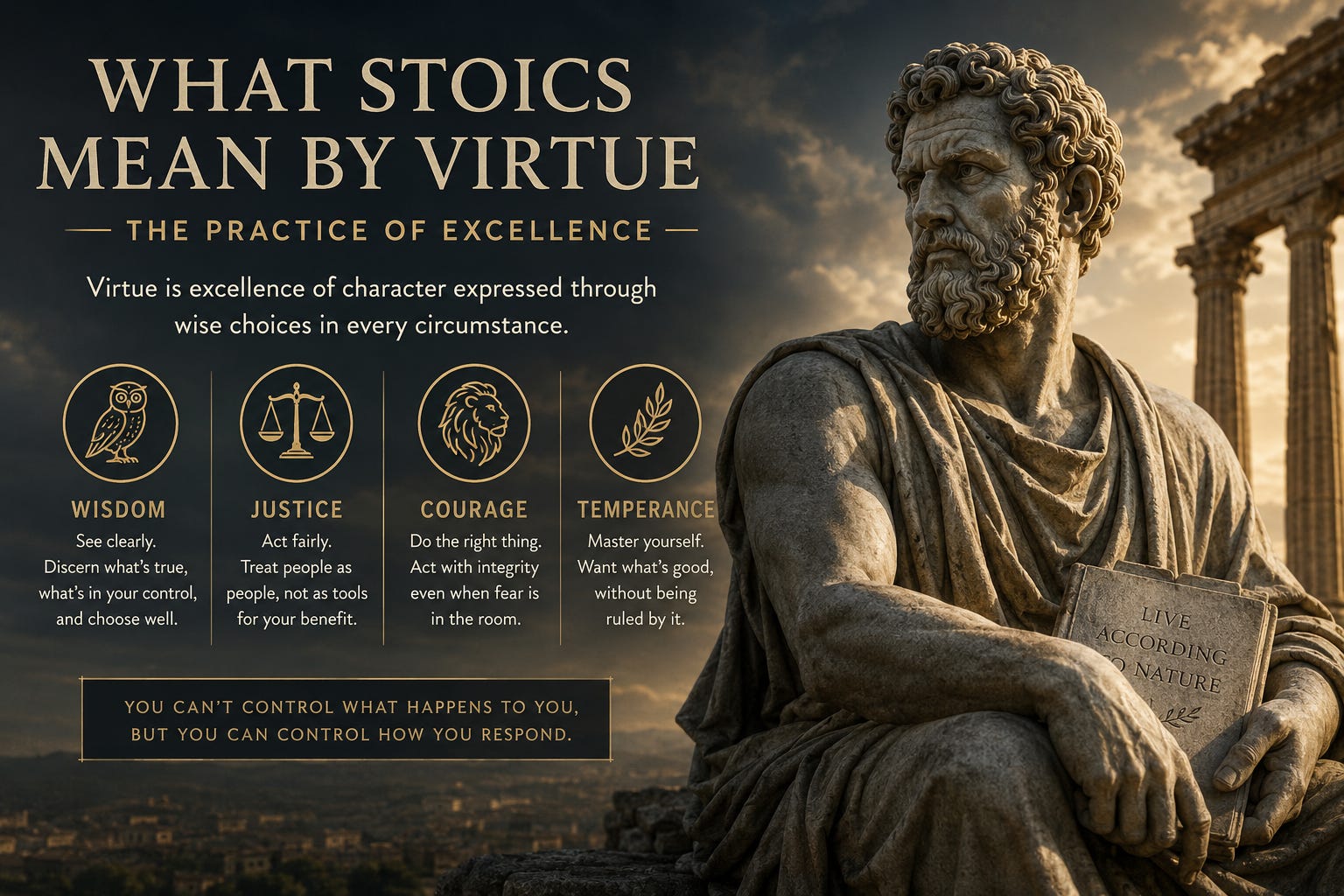
Stoics often group virtue into four qualities: wisdom, justice, courage, and temperance. These aren’t separate “personality traits.” They’re overlapping skills you practice in real situations.
WISDOM: SEEING CLEARLY AND CHOOSING WELL
Wisdom is practical judgment. It’s not trivia knowledge or cleverness. It’s the ability to see what’s actually happening, notice what you’re telling yourself about it, and choose the response that fits reality.
Modern translation: Can I distinguish facts from stories? Can I identify what’s in my control? Can I choose the next best action rather than the most emotionally satisfying one?
A quick example: You send a message and don’t get a reply. The fact is silence. The story is “They’re disrespecting me” or “I’m being rejected.” Wisdom pauses and asks: What else could be true? What do I actually know? What action aligns with my values? Sometimes the wise move is to follow up calmly. Sometimes it’s to wait. Sometimes it’s to stop chasing. Wisdom isn’t passive; it’s accurate.
JUSTICE: FAIRNESS, DUTY, AND NOT USING PEOPLE
Stoic justice is bigger than “don’t break the law.” It’s the commitment to treat people as people—not as tools for your ego, convenience, or advantage.
Modern translation: Am I being fair? Am I being honest? Am I honoring my roles—parent, friend, colleague, neighbor—without turning them into performances?
Consider a workplace scenario: You’re leading a project, and someone on your team made a mistake that will reflect badly on you. You can protect your image by throwing them under the bus. You can also protect the team (and the truth) by taking responsibility for the system that allowed the error, addressing it privately, and fixing the process.
Justice doesn’t mean being soft. Sometimes justice requires hard conversations, clear boundaries, and consequences. But it refuses the cheap win that costs someone else their dignity.
COURAGE: DOING THE RIGHT THING WITH FEAR IN THE ROOM
Courage is not fearlessness. It’s acting in line with reason and values while fear is present. Fear of conflict. Fear of losing approval. Fear of failure. Fear of looking foolish.
Modern translation: Can I tolerate discomfort in service of what matters?
A small anecdote: Imagine you’re at dinner and someone makes a cruel joke about a group of people. Everyone laughs awkwardly. You feel the heat rise—part anger, part fear. Courage might be a simple, steady line: “I don’t find that funny.” Or “Let’s not do that.” You may not change their worldview in that moment. But you protect your integrity. You refuse to rent your silence to something you don’t respect.
Courage also shows up privately: admitting you were wrong, apologizing without excuses, starting again after a setback, going to therapy, telling the truth you’ve been avoiding.
TEMPERANCE: SELF-CONTROL THAT CREATES FREEDOM
Temperance is moderation, restraint, and inner discipline. Not repression. Not joylessness. It’s the ability to say: “I can want this without being ruled by it.”
Modern translation: Can I choose my actions instead of being dragged by impulses?
Think of your phone at night. You’re exhausted, you open an app “for a minute,” and suddenly an hour is gone. Temperance isn’t moral panic about screen time. It’s the recognition that attention is your life. Temperance is putting the phone in another room because you decided sleep matters more than stimulation.
Temperance is also emotional. It’s not “never feel anger.” It’s not “never desire.” It’s refusing to let emotions and appetites seize the steering wheel.
VIRTUE IS UNIFIED: WHY ONE VIRTUE NEEDS THE OTHERS
Stoics treat virtue as a unified whole because these qualities depend on each other.
Courage without wisdom becomes recklessness.
Justice without temperance becomes self-righteousness.
Temperance without justice becomes mere self-improvement.
Wisdom without courage becomes clever avoidance.
In modern terms: good decision-making is holistic. The right action usually requires clarity (wisdom), consideration of others (justice), willingness to endure discomfort (courage), and restraint from ego or impulse (temperance).
VIRTUE IN ACTION: A MODERN DECISION-MAKING FILTER
If you want to translate Stoic virtue into something you can use on a random Tuesday, try this quick filter when you’re stuck:
1) What’s the situation, in plain facts?
2) What part is up to me right now?
3) What would a wise person do here?
4) What would be fair to everyone involved (including me)?
5) What discomfort am I avoiding, and is it worth facing?
6) What impulse is pushing me, and do I need to slow down?
This isn’t about becoming a robot. It’s about becoming less reactive and more intentional.
A practical example: You’re offered a promotion that comes with more money and status, but it requires you to manage in a way that clashes with your values—pressure people, blur ethical lines, play politics. Stoic virtue doesn’t automatically say “reject success.” It asks: What will this role train me to become? Will I be able to act justly? Will I be able to be honest? Will I be able to sleep at night? If not, the “gain” may be a loss.
WHY VIRTUE DOESN’T DEPEND ON WINNING
One of the most liberating parts of Stoic virtue is that it doesn’t require perfect outcomes. You can do everything right and still lose. You can tell the truth and still be misunderstood. You can work hard and still get laid off. You can love someone well and still be left.
Stoicism doesn’t call that a tragedy of character. It calls it life.
Virtue is what makes you resilient without becoming bitter. It lets you say: “I can’t guarantee results, but I can guarantee my effort, my honesty, my fairness, my restraint, my courage.” That’s not a consolation prize. That’s the foundation of self-respect.
CONCLUDING TAKEAWAY
Stoic “virtue” isn’t an outdated moral badge. It’s the practical commitment to live with excellence of character: see clearly, act fairly, face discomfort, and govern yourself. It’s the one thing you can always practice, in any circumstance, and the one thing that can’t be taken from you unless you surrender it.
If you want a simple way to remember it: virtue is being the kind of person you don’t have to apologize for later.
If you want more essays like this—practical Stoicism without the fluff—subscribe and read along each day.
 Practice Stoicism every day.