The Stoic View of Success:
If you’ve ever hit a goal and felt strangely empty afterward, you’ve already brushed up against a Stoic insight: the finish line doesn’t have the power we think it does. The promotion, the launch, the personal record, the applause—these things can feel like they’ll finally settle something inside us. And then the moment arrives, and the mind immediately reaches for the next rung. Or worse: the moment doesn’t arrive at all, and we’re left questioning our worth. Stoicism offers a different way to win—one that keeps you ambitious, but frees you from being owned by the scoreboard.
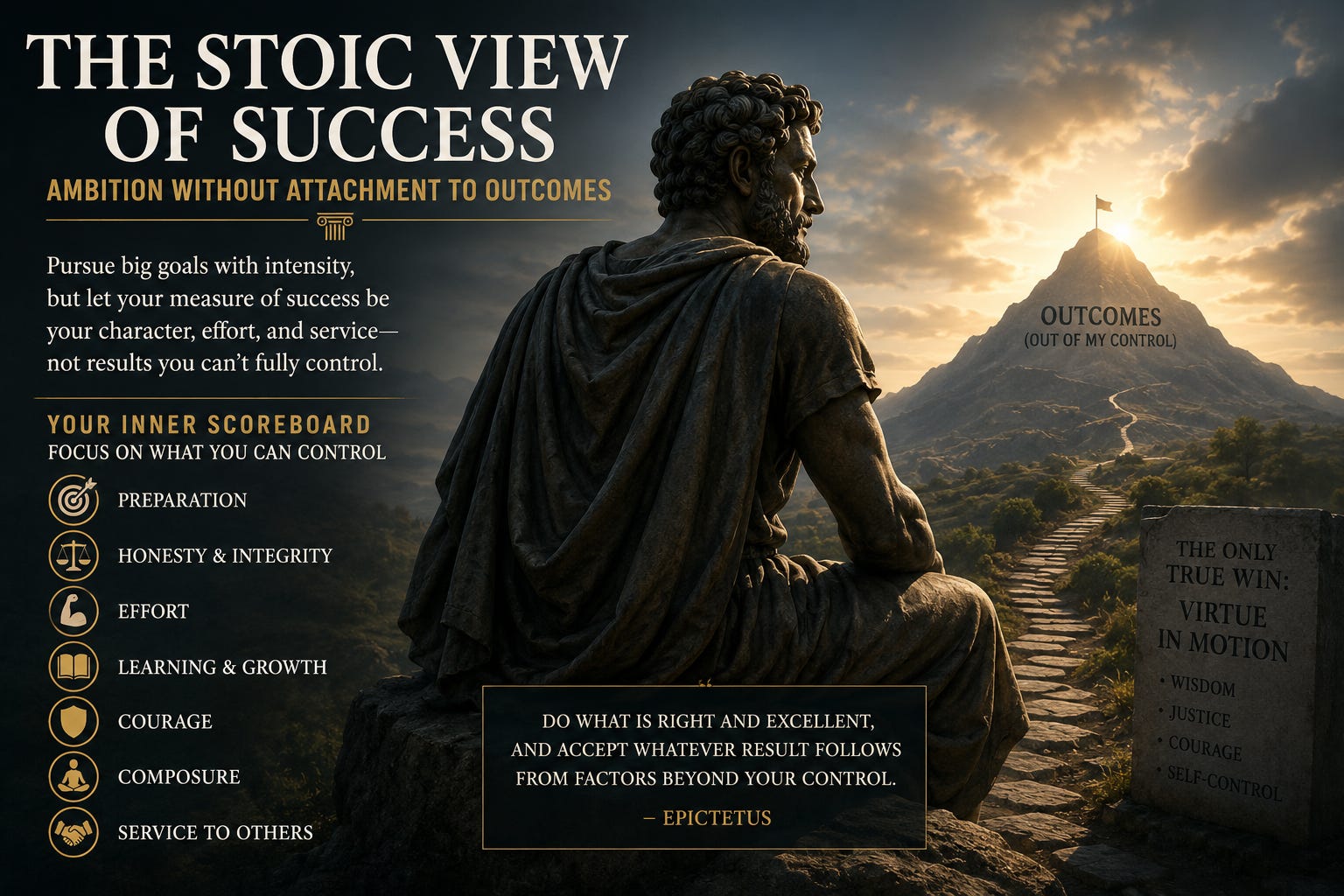
Thesis: Stoicism doesn’t ask you to quit striving; it asks you to relocate success from outcomes you can’t fully control to the quality of your character, effort, and service—so you can pursue big goals with intensity while staying steady when results fluctuate.
WHAT STOICISM MEANS BY “SUCCESS”
In the modern world, success is usually measured by external markers: money, status, visibility, power, influence, comfort, credentials. Stoicism doesn’t deny that these things can be useful. It simply refuses to treat them as the final verdict on a life.
The Stoic definition of success is closer to this: living in accordance with virtue—wisdom, justice, courage, and self-control—while meeting your responsibilities and contributing to the common good. Under that definition, a person can fail publicly and still succeed inwardly. And a person can “win” publicly while quietly losing themselves.
This shift is not semantic. It changes your emotional dependence. If your identity is fused to outcomes, then every setback becomes a threat to your self-worth. If your identity is anchored in your choices and character, then outcomes become information—sometimes pleasant, sometimes painful, always instructive, never definitive.
AMBITION, BUT WITH A DIFFERENT TARGET
There’s a caricature of Stoicism that says it’s about lowering expectations until nothing can hurt you. That’s not Stoicism; that’s withdrawal.
Stoic ambition is not smaller. It’s cleaner.
The target is no longer “I must get X to be okay.” The target becomes “I will do what is right and excellent, and I will accept whatever result follows from factors beyond my control.” This is not passivity. It’s disciplined engagement.
Think of the difference between two athletes. Both train hard. Both want to win. One believes victory will finally prove they are worthy; the other sees victory as a preferred outcome but not the measure of their worth. The first athlete is more likely to panic, play tight, and crumble under pressure. The second is more likely to play freely, recover faster from mistakes, and keep their composure. Detachment from outcome can actually improve performance because it reduces the fear that hijacks judgment.
AMBITION WITHOUT ATTACHMENT: THE INNER SCOREBOARD
A practical Stoic move is to create an “inner scoreboard”—a way of measuring success by what you can control.
You can’t fully control whether your project goes viral, whether your boss notices, whether the market shifts, whether a client changes their mind, whether your competitor undercuts you, whether illness interrupts your plans. But you can control:
Your preparation.
Your honesty.
Your effort.
Your patience.
Your ability to learn.
Your courage to have difficult conversations.
Your restraint when you’re tempted to cut corners.
Your willingness to take responsibility.
Your fairness to others.
Your composure under pressure.
This is not self-consolation. It’s realism.
A short anecdote: imagine you apply for a role you genuinely want. You do the work: you prepare thoughtfully, you present your experience clearly, you follow up professionally. You don’t get it. If your definition of success is “getting the job,” you failed. If your definition is “acting with excellence and integrity in the process,” you succeeded—and you’re now in a stronger position for the next opportunity. The outcome stings, but it doesn’t poison your self-respect.
The Stoic doesn’t pretend disappointment is pleasant. They simply refuse to turn disappointment into despair.
THE STOIC “WIN”: VIRTUE IN MOTION
A common modern trap is confusing motion with meaning. We hustle, optimize, network, grind—then wonder why our days feel thin. Stoicism insists that action must be guided by virtue, or else ambition becomes a machine that consumes the person operating it.
This is where Stoicism becomes surprisingly practical. Virtue isn’t abstract; it’s a decision-making tool.
Wisdom asks: What’s actually true here? What matters? What’s the long-term consequence?
Justice asks: Who is affected? Am I being fair? Am I honoring obligations?
Courage asks: What am I avoiding because I’m afraid? What must be faced?
Self-control asks: What impulse is driving me? What would I choose if I weren’t craving approval or comfort?
When your ambition is filtered through these questions, you don’t become less effective. You become less reckless. You stop chasing the wrong prizes.
Consider a manager under pressure to hit quarterly numbers. One path is to squeeze the team with fear, cut ethical corners, and manipulate reporting. It might “work” short term, but it corrodes trust and creates long-term fragility. Another path is to be transparent, set clear standards, protect the team from chaos where possible, and make hard decisions without deception. That path might be slower and less glamorous, but it builds something sturdier: a culture of reliability. Stoic success is often quieter, but it lasts.
SERVICE: AMBITION THAT DOESN’T ROT
Many people fear that detaching from outcomes will drain motivation. But Stoicism doesn’t replace ambition with indifference; it replaces ego-driven ambition with service-driven ambition.
Ego says: “I need to win so I can feel secure.”
Service says: “I want to do this well because it helps people, improves something, honors a responsibility.”
Service is a more stable fuel source. Ego is volatile: it spikes with praise and collapses with criticism. Service can withstand being misunderstood, delayed, or under-credited because the purpose is larger than applause.
A small example: a teacher might never become famous, never be widely recognized, never have their “work” monetized at scale. Yet they can live a profoundly successful life by showing up with patience, clarity, and care—day after day—helping students become more capable human beings. From a Stoic lens, that’s not “less than” success. That’s success in its purest form.
Even in competitive fields, this matters. If you’re building a product, leading a team, practicing medicine, writing, coaching, or running a business, service keeps you honest. It asks: Are we solving real problems? Are we treating people as people? Are we building something we’d be proud to defend?
THE DISCIPLINE OF PROCESS: DO YOUR JOB, RELEASE THE REST
Stoicism is often summarized as focusing on what you can control. In modern terms, that becomes a discipline of process.
You can set a goal to publish a book, but you can’t force the market’s reaction. You can set a goal to improve your health, but you can’t guarantee perfect outcomes. You can set a goal to build a company, but you can’t control macroeconomic shocks. The Stoic approach is to commit fully to the inputs—writing daily, training consistently, making the calls, refining the craft—while mentally releasing the demand that the world must respond the way you want.
This release is not resignation. It’s a refusal to bargain with reality.
There’s a subtle freedom here: when you stop needing a particular outcome to validate you, you become more willing to take the right risks. You can pitch the bold idea. You can ask for the raise. You can start the project. You can apologize. You can walk away from a deal that violates your standards. Attachment makes you timid and compromised; detachment makes you brave and clean.
HANDLING PRAISE AND BLAME LIKE A STOIC
Modern success is noisy. People praise you loudly, then move on. People criticize you harshly, sometimes unfairly. Stoicism teaches you to treat both as weather.
Praise can be pleasant, but it’s not proof of virtue. Blame can be painful, but it’s not proof of failure.
A useful practice is to translate praise and blame into feedback without letting either become identity. If someone compliments your work, you can accept it with gratitude and return to the process. If someone criticizes you, you can ask: Is there something true here I can use? If yes, improve. If not, let it pass.
This is especially important for anyone building in public—leaders, creators, entrepreneurs, parents even. The Stoic posture is: “I will listen carefully, correct what’s mine to correct, and continue.”
WHAT THIS LOOKS LIKE IN MODERN LIFE
A Stoic view of success doesn’t mean you stop caring. It means you care in the right way.
You still set goals. You still plan. You still compete. You still want the promotion, the growth, the win. But you stop making a hostage of your peace.
You define success before the outcome arrives.
Success is:
Doing the work when no one is watching.
Choosing integrity when shortcuts are available.
Speaking honestly when it’s inconvenient.
Staying steady when plans change.
Treating people fairly when you have leverage.
Learning quickly from mistakes without self-hatred.
Persisting without bitterness.
And yes—sometimes you also get the external win. Stoicism doesn’t forbid that. It just refuses to worship it.
CONCLUDING TAKEAWAY: REDEFINE “WINNING” SO LIFE CAN’T HOLD IT OVER YOU
The Stoic view of success is not about shrinking your life. It’s about making your life unbribable.
When you measure success by virtue, effort, and service, you become harder to manipulate—by other people, by trends, by fear, by ego, by the constant pressure to prove yourself. You can pursue meaningful ambitions with full force and still sleep at night, because your self-respect doesn’t depend on the next email, the next metric, the next verdict.
Aim high. Work hard. Be useful. And let outcomes be what they are: results, not rulers.
If you want more reflections like this—practical Stoicism for modern ambition—subscribe if you’re building something and don’t want to lose yourself in the process.
 Practice Stoicism every day.