The Four Stoic Virtues Explained: Wisdom, Courage, Justice, and Temperance
You don’t need more motivation. You need a better compass. Most of what exhausts us isn’t the workload itself—it’s the constant decision-making without a clear standard: Should I speak up or stay quiet? Push harder or rest? Say yes to help or protect my time? Stoicism offers a simple, demanding answer: measure your choices by virtue, not by mood.
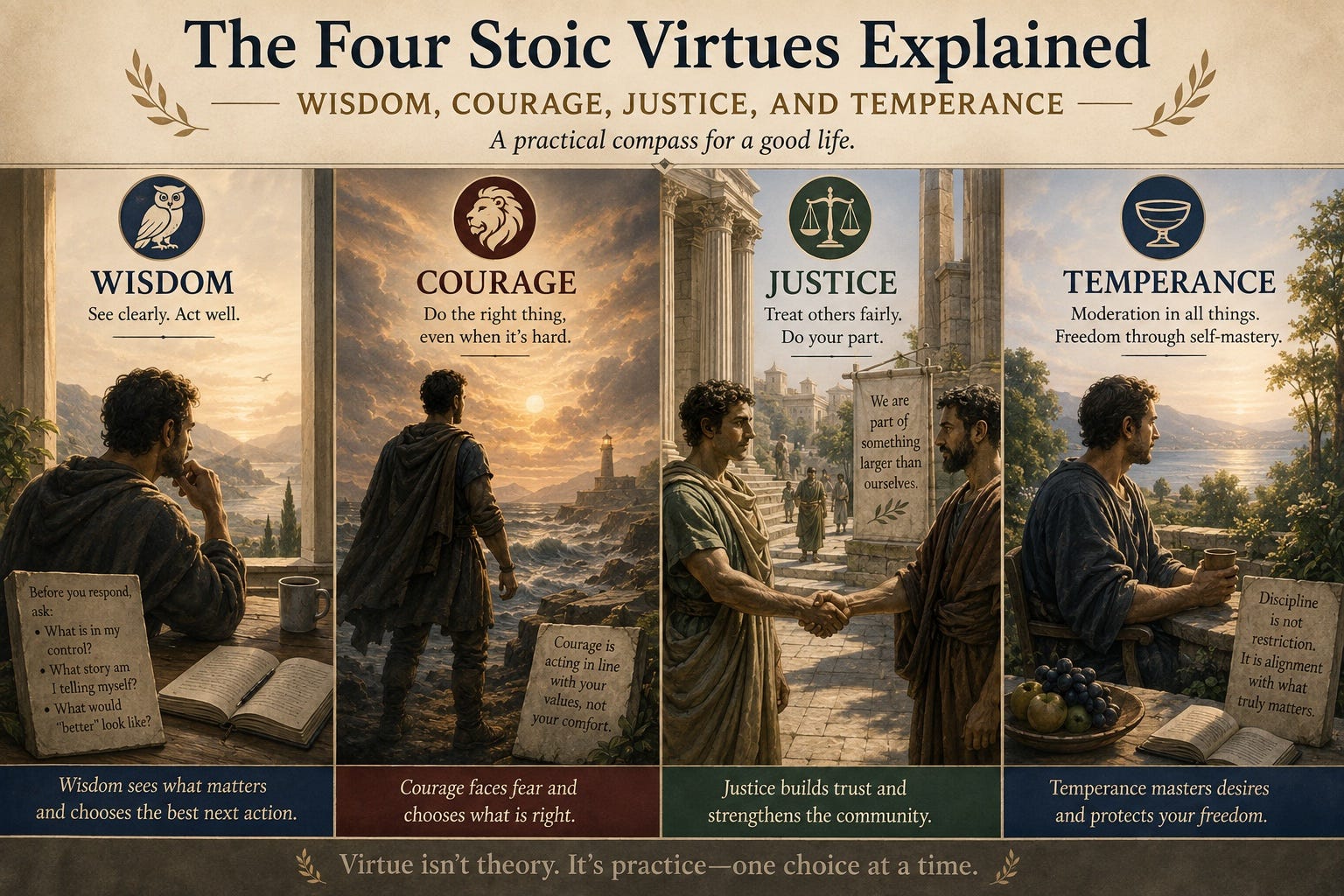
Here’s the thesis: The Stoics believed the good life is built on four virtues—wisdom, courage, justice, and temperance—and that these virtues are not abstract ideals but practical skills. When you make them concrete, they become a daily decision framework for relationships, work, and personal habits. You won’t apply them perfectly. But you can apply them consistently, and consistency changes everything.
WISDOM: SEEING CLEARLY BEFORE ACTING
Wisdom, in Stoic terms, is not trivia or cleverness. It’s good judgment. It’s the ability to see what’s actually happening, what matters, what doesn’t, and what the best next action is.
A simple way to make wisdom actionable is to ask three questions before you respond:
1) What is in my control here?
2) What story am I telling myself about this?
3) What would “better” look like, not “perfect”?
Relationships: Imagine you’re upset because a friend hasn’t replied in days. The unwise move is to treat your interpretation as fact: “They don’t care.” Wisdom pauses: the fact is “no reply yet.” Your story is “rejection.” What’s in your control is your next message, your tone, and your boundaries. “Better” might be a calm check-in: “Hey, haven’t heard from you—everything okay?” Wisdom turns drama into clarity.
Work: A manager gives you blunt feedback. The unwise reaction is to defend your ego or spiral into self-criticism. Wisdom separates signal from noise. Signal: what specifically needs improvement. Noise: the sting, the imagined judgment, the catastrophic future. Wisdom asks: “What is the next measurable step?” Then it does that step.
Personal habits: You miss a workout or overeat. Wisdom doesn’t moralize it into “I’m undisciplined.” It treats it as data. “What led to this? Was I tired? Did I skip lunch? Did I plan poorly?” Wisdom is compassionate without being permissive. It replaces shame with adjustment.
A short anecdote: Think of a person you trust because they don’t overreact. When something goes wrong, they get quieter and clearer. That’s wisdom in the Stoic sense. It’s not passive. It’s focused.
A practical practice: Before any important conversation, write one sentence: “The outcome I want is ____.” Then write one more: “The virtue I will use is ____.” You’re training your mind to lead with judgment, not impulse.
COURAGE: DOING THE RIGHT THING WHILE AFRAID
Courage is often misunderstood as fearlessness. The Stoics would call that unrealistic. Courage is the willingness to act according to your values even when fear, discomfort, or social pressure is present.
Actionable courage looks like choosing the honorable discomfort over the comfortable compromise.
Relationships: Courage is telling the truth with care. It might mean saying, “I felt hurt when you canceled last minute,” instead of pretending you’re fine and letting resentment grow. Or it might mean ending a relationship that is quietly shrinking you. Courage doesn’t mean being harsh. It means being honest.
There’s also courage in restraint. If you’re in an argument and you feel the urge to win, courage might be: “I’m getting heated. I want to pause and come back to this later.” Walking away from a pointless fight can take more courage than continuing it.
Work: Courage is speaking up when something is wrong. It’s raising a concern about an unethical shortcut, admitting a mistake early, or asking for clarity when everyone else is pretending to understand. Courage is also doing the work that exposes you to judgment: shipping the project, presenting the idea, applying for the role.
A practical example: You’re in a meeting and someone takes credit for your work. The easy path is silence and bitterness. The reckless path is public humiliation. Courage with wisdom might sound like: “I’m glad the project landed well. I want to clarify one piece—I handled the analysis and the draft, and I’d like that reflected going forward.” Calm, specific, and steady.
Personal habits: Courage is sitting with cravings, boredom, loneliness, or anxiety without immediately numbing them. It’s doing the uncomfortable basics: sleeping on time, going for the walk, making the appointment, starting the task you’ve been avoiding. Courage is also asking for help. Stoicism is not solitary pride; it’s inner strength paired with clear action.
A practical practice: Pick one “avoidance task” each day and do the first two minutes. Courage often begins as a tiny breach in resistance. Once you start, the fear loses some of its authority.
JUSTICE: TREATING PEOPLE FAIRLY, INCLUDING WHEN YOU’RE ANNOYED
Justice, for the Stoics, is not only about laws or courts. It’s about how you treat other people: fairness, honesty, responsibility, and a commitment to the common good. It’s the virtue that prevents Stoicism from becoming self-centered “calmness for me” while everyone else deals with the consequences.
Relationships: Justice is keeping your promises and being clear when you can’t. It’s not using guilt, silent treatment, or manipulation to get your way. It’s listening to understand, not listening to reload. Justice also means giving people the dignity of directness. If something isn’t working, don’t punish them with ambiguity. Tell them respectfully.
A concrete example: A partner forgets something important. Justice doesn’t keep a secret scorecard. It addresses the issue and looks for a workable system: “This matters to me. Can we set a reminder together?” Justice aims at repair, not revenge.
Work: Justice is giving credit where it’s due and taking responsibility when it’s yours. It’s not hoarding information to look indispensable. It’s not throwing someone under the bus to protect your image. It’s also fairness in leadership: setting clear expectations, giving feedback without cruelty, and making decisions that consider the team, not just your convenience.
A short anecdote: Many workplaces have a person who is “brilliant” but leaves a trail—missed handoffs, sarcastic comments, credit taken, blame shifted. Stoicism would call that a failure of justice, no matter how productive they appear. Over time, injustice is expensive. It erodes trust, and trust is the real engine of any team.
Personal habits: Justice includes how you treat yourself, but in a specific way: you owe yourself honesty. If your habits are harming you, justice is admitting it. You also owe the people around you your best effort at being reliable. If your scrolling habit makes you absent at dinner, justice is adjusting. Not out of guilt, but out of responsibility.
A practical practice: Before you send a message when you’re irritated, ask: “If this were read aloud to a room of people I respect, would I stand by it?” Justice is often a tone check.
TEMPERANCE: CHOOSING ENOUGH IN A WORLD THAT SELLS MORE
Temperance is moderation, self-control, and balance. It’s not deprivation. It’s freedom from being yanked around by appetite—whether that appetite is for food, attention, praise, shopping, gossip, or constant stimulation.
Temperance becomes actionable when you define “enough” ahead of time, rather than trying to improvise boundaries while tempted.
Relationships: Temperance is not saying everything you think. It’s not escalating. It’s knowing when to stop talking and start listening. It’s also emotional moderation: letting yourself feel anger or excitement without letting those feelings drive the car.
A concrete example: You’re upset and want to send a sharp text. Temperance is waiting ten minutes. Not to suppress the truth, but to deliver it cleanly. Temperance protects your relationships from your temporary moods.
Work: Temperance is sustainable ambition. It’s refusing the identity of “always on.” It’s taking breaks before you break. It’s also restraint with ego: not needing to be seen as the smartest person in the room, not replying instantly to prove you’re dedicated, not taking on every task to feel important.
Personal habits: Temperance is where most people think discipline lives: food, alcohol, screens, spending, sleep. The Stoic approach is practical: you don’t fight temptation forever; you redesign the conditions. You remove friction from good habits and add friction to bad ones. You decide your limits when you’re calm.
A practical practice: Choose one “default limit” for a week. Examples: no phone in bed, one dessert on weekends, social media only after lunch, one drink max, lights out by 11. Temperance isn’t a grand vow; it’s a small rule you can keep.
HOW THE VIRTUES WORK TOGETHER: A DAILY DECISION FILTER
The four virtues aren’t separate lanes; they’re a system.
Wisdom tells you what’s true and what matters.
Courage helps you act on it despite fear.
Justice ensures your action is fair and considerate of others.
Temperance keeps you from overdoing, overreacting, or self-sabotaging.
Try this in a real scenario: You’re offered a promotion that pays more but will consume your life.
Wisdom: What will this actually require? What are the trade-offs? What do I value right now?
Courage: Can I negotiate? Can I say no if it’s wrong for my life, even if it bruises my ego?
Justice: How will this affect my family, my team, and my commitments? Am I leaving others holding the bag?
Temperance: Am I chasing status? Am I able to set boundaries so the role doesn’t become an addiction?
Or a relationship scenario: You feel distant from someone you care about.
Wisdom: Name the real issue.
Courage: Initiate the conversation.
Justice: Speak respectfully and listen.
Temperance: Don’t turn one bad week into a dramatic verdict about the entire relationship.
CONCLUDING TAKEAWAY
The Stoic virtues are not a personality type. They’re a practice. When you feel stuck, don’t ask, “What do I feel like doing?” Ask, “What would wisdom, courage, justice, and temperance do here?” Then do the smallest version of that today.
You won’t control outcomes. But you can control the quality of your choices. And over time, the quality of your choices becomes the quality of your life.
If you want more practical Stoic ideas you can use in your relationships, work, and habits, subscribe and read along each day.
 Practice Stoicism every day.