Stoicism vs Toxic Positivity: Realistic Optimism for Hard Days
If you’ve ever been told “look on the bright side” while your chest felt tight and your world felt like it was shrinking, you know how lonely positivity can sound. Not because hope is bad, but because denial is. When life hurts, a forced smile can feel like a second injury: first the problem, then the pressure to pretend it isn’t a problem.
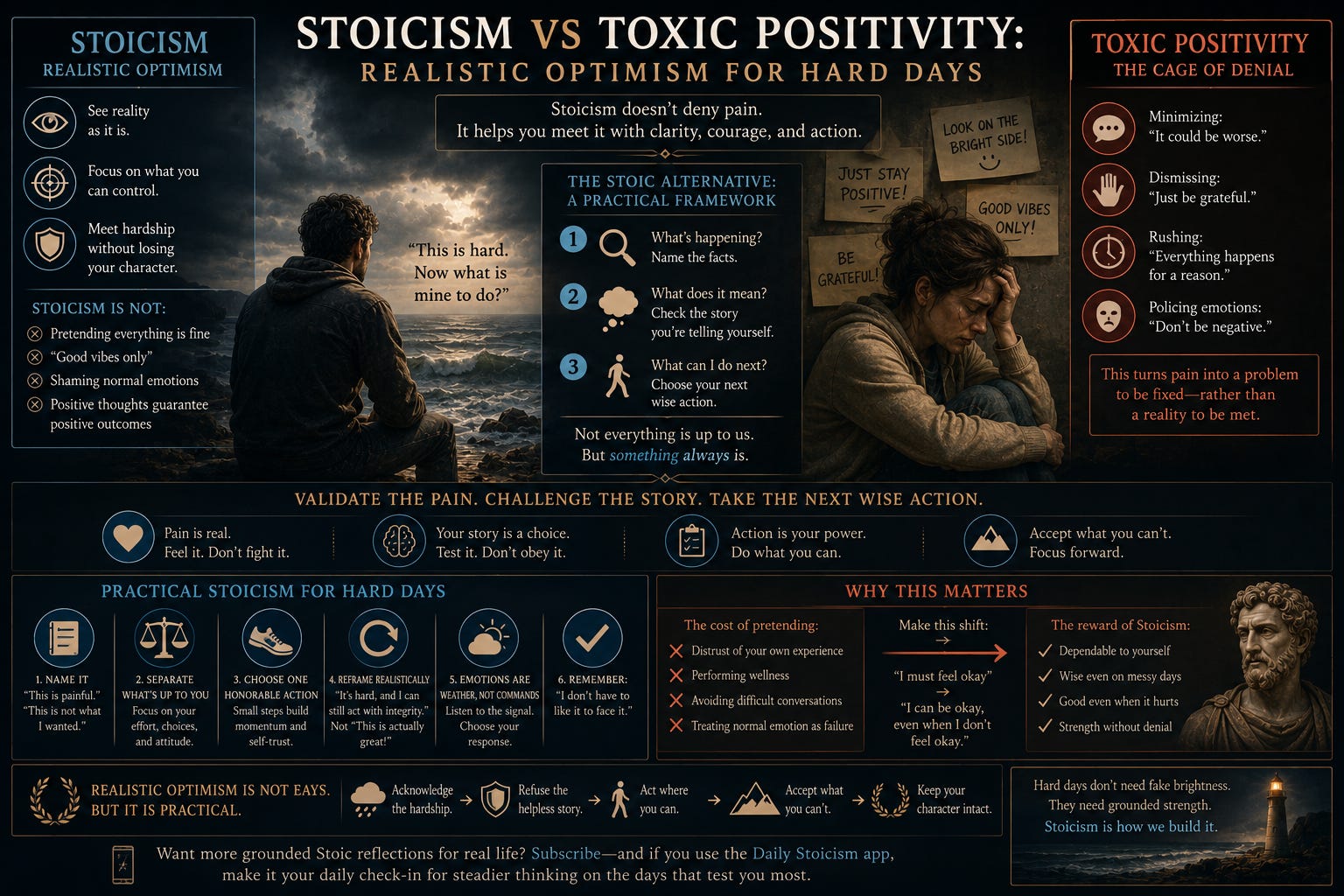
Here’s the thesis: Stoicism is not “just think positive.” It’s a practical philosophy of realistic optimism—one that makes room for pain, names reality clearly, and then asks a better question: given what’s true, what’s the next wise action I can take?
WHAT STOICISM IS (AND ISN’T)
Stoicism gets misread as emotional suppression or relentless cheerfulness. In reality, it’s closer to emotional honesty plus disciplined agency.
Stoicism is:
- A commitment to seeing reality as it is, not as we wish it were.
- A focus on what you can control (your judgments, choices, and actions) and what you can’t (other people, outcomes, the past).
- A method for meeting hardship without surrendering your character.
Stoicism is not:
- Pretending everything is fine.
- “Good vibes only.”
- Shaming yourself for feeling grief, anger, fear, or disappointment.
- Believing that positive thinking guarantees positive outcomes.
A Stoic doesn’t say, “This isn’t bad.” A Stoic says, “This is hard. Now what is mine to do?”
TOXIC POSITIVITY: WHEN OPTIMISM TURNS INTO A CAGE
Toxic positivity isn’t optimism. It’s optimism used as a defense mechanism—an attempt to outrun discomfort by editing reality. It often shows up as:
- Minimizing: “It could be worse.”
- Dismissing: “Just be grateful.”
- Rushing: “Everything happens for a reason.”
- Policing emotions: “Don’t be negative.”
The issue isn’t that these phrases are always wrong. The issue is timing and intent. When someone is in pain, the first need is usually validation, not reframing. If you skip that step, “positivity” becomes a way to avoid empathy—either your own or someone else’s.
Worse, toxic positivity can quietly imply that suffering is a personal failure. If you were stronger, more evolved, more grateful, you wouldn’t feel this way. That’s not encouragement; that’s blame wearing a bright costume.
Stoicism offers a different path: it doesn’t demand that you feel good. It asks that you stay oriented toward what’s good—meaningful action, integrity, steadiness—especially when you don’t feel good.
THE STOIC ALTERNATIVE: REALISTIC OPTIMISM
Realistic optimism starts with a clear-eyed inventory:
1) What’s happening?
2) What does it mean (and what am I telling myself it means)?
3) What can I do next?
This is where Stoicism shines. It separates facts from interpretations. The fact might be: “I lost my job.” The interpretation might be: “I’m doomed” or “I’m worthless” or “I’ll never recover.” Stoicism doesn’t tell you to replace that with a glittery slogan. It invites you to test your interpretation.
Is it true that you’re doomed? Or is it true that you’re scared and uncertain, and you need a plan?
Is it true that you’re worthless? Or is it true that you’re in a painful transition, and your worth isn’t up for negotiation?
Realistic optimism isn’t the belief that everything will work out. It’s the belief that you can meet whatever happens with your best effort and your best character. That’s a sturdier kind of hope—one that doesn’t collapse when the forecast changes.
A SHORT ANECDOTE: TWO WAYS TO FACE THE SAME BAD NEWS
Imagine two people get the same phone call: a parent is seriously ill.
Person A (toxic positivity) says, “We have to stay positive. Don’t cry. If we focus on healing energy, it’ll be fine.” They might mean well, but the message is: your fear and grief are inconvenient. So the emotions get shoved into a closet, where they grow louder.
Person B (Stoic realism) says, “This is frightening. I love them. I don’t know what will happen.” They breathe. They let the feelings exist without turning them into prophecy. Then they ask: “What’s within my control today?” Maybe it’s making calls, showing up, asking the doctor the right questions, taking a walk so they can sleep, speaking kindly to siblings instead of snapping.
Both people want the same thing: for the parent to be okay. But only one approach builds stability. Stoicism doesn’t remove pain; it prevents pain from becoming chaos.
VALIDATING PAIN WITHOUT SURRENDERING AGENCY
One of the most important distinctions is this: Stoicism validates the emotion while challenging the story that makes the emotion unbearable.
Pain is real. Loss is real. Disappointment is real. Stoicism doesn’t argue with that. It argues with the leap from “this hurts” to “I can’t handle this.”
You can feel devastated and still take the next step.
You can feel anxious and still make a good decision.
You can feel angry and still choose restraint.
You can feel grief and still be gentle with yourself and others.
This is not coldness. It’s courage.
On hard days, many people swing between two extremes:
- Collapse: “I can’t do anything until I feel better.”
- Denial: “I’m fine, I’m fine, I’m fine.”
Stoicism offers a third option:
- Presence plus action: “I feel what I feel, and I’ll do what I can.”
That’s the heart of agency: not controlling the storm, but steering the ship.
PRACTICAL STOICISM FOR HARD DAYS
When life is heavy, you don’t need a grand philosophy lecture. You need a few reliable moves you can repeat.
Name the reality plainly.
Try: “This is painful.” “This is disappointing.” “This is not what I wanted.”
Plain language keeps you grounded. It prevents spiraling into drama or denial.
Separate what’s up to you from what isn’t.
Ask: “What part of this is mine to influence?” Your effort, your attitude, your next conversation, your boundaries, your schedule, your apology, your courage—these are yours. Other people’s reactions, the past, the outcome—those aren’t.
Choose one honorable action.
Not ten. One. Send the email. Take the walk. Drink water. Make the appointment. Tell the truth. Apologize. Rest. The point is to prove to yourself that you’re not helpless.
Practice “realistic reframing,” not forced reframing.
Forced reframing says: “This is actually great!”
Realistic reframing says: “This is bad, and I can still learn something,” or “This is hard, and I can still act with integrity,” or “This is unfair, and I can still choose my response.”
Let emotions be weather, not commands.
Feelings provide information, not instructions. Anxiety might say, “Watch out.” Grief might say, “This mattered.” Anger might say, “A boundary was crossed.” Listen, then decide. You can respect the signal without obeying the impulse.
A simple line that often helps: “I don’t have to like it to face it.”
WHY THIS MATTERS: THE COST OF PRETENDING
Toxic positivity often looks harmless until you notice what it trains you to do:
- It trains you to distrust your own experience.
- It trains you to perform wellness.
- It trains you to avoid difficult conversations.
- It trains you to treat normal human emotion as a malfunction.
Stoicism does the opposite. It trains you to become dependable to yourself. It builds a quiet confidence: even if today is messy, you can still be wise. Even if you’re hurting, you can still be good.
That’s a powerful shift: from “I must feel okay” to “I can be okay even when I don’t feel okay.”
A NOTE FOR THE “I’M NOT STOIC ENOUGH” CROWD
Many people hear Stoicism and think it’s a personality type: calm, unbothered, immune to stress. That’s not the assignment. Stoicism is a practice. You don’t “have it.” You return to it.
Some days you’ll do great. Some days you’ll spiral, complain, or snap. Stoicism doesn’t demand perfection. It asks for a reset: come back to what you can control. Come back to the next right action.
That’s why small daily reminders matter. Not because you can memorize a quote and become invincible, but because you can train your attention—like strengthening a muscle that helps you stand up inside your own life.
If you use the Daily Stoicism app (iOS)/(Web), this is exactly the kind of day it’s built for: the day you don’t want a motivational poster, you want a steady hand on the wheel. A daily reflection, a short exercise, a quick journal prompt—something that helps you shift from overwhelm to agency without denying what you feel.
CONCLUDING TAKEAWAY
Stoicism is not toxic positivity. It doesn’t ask you to paint a smile over a wound. It asks you to clean the wound, tell the truth about it, and then do what healing requires.
Realistic optimism is simple, but not easy:
- Acknowledge the hardship.
- Refuse the helpless story.
- Act where you can.
- Accept what you can’t.
- Keep your character intact.
Hard days don’t need fake brightness. They need grounded strength. Stoicism is one way to practice that strength—quietly, consistently, and without lying to yourself.
 Practice Stoicism every day.