Stoicism for Anxiety: What It Helps With (and What It Doesn’t)
Anxiety has a way of turning the volume up on everything. A small email feels like a verdict. A harmless sensation in the body feels like a warning siren. A future conversation becomes a courtroom drama you rehearse for days. And the hardest part is that anxiety often comes with a second layer: the shame of having it. “Why can’t I just be normal? Why can’t I just stop thinking?”
Stoicism can help with that second layer—and, in many cases, with the first. Not by making you invulnerable, not by “positive thinking” your way out of fear, and not by pretending you can control what you can’t. But by giving you a sturdy set of distinctions and practices that reduce unnecessary suffering and increase your ability to respond wisely.
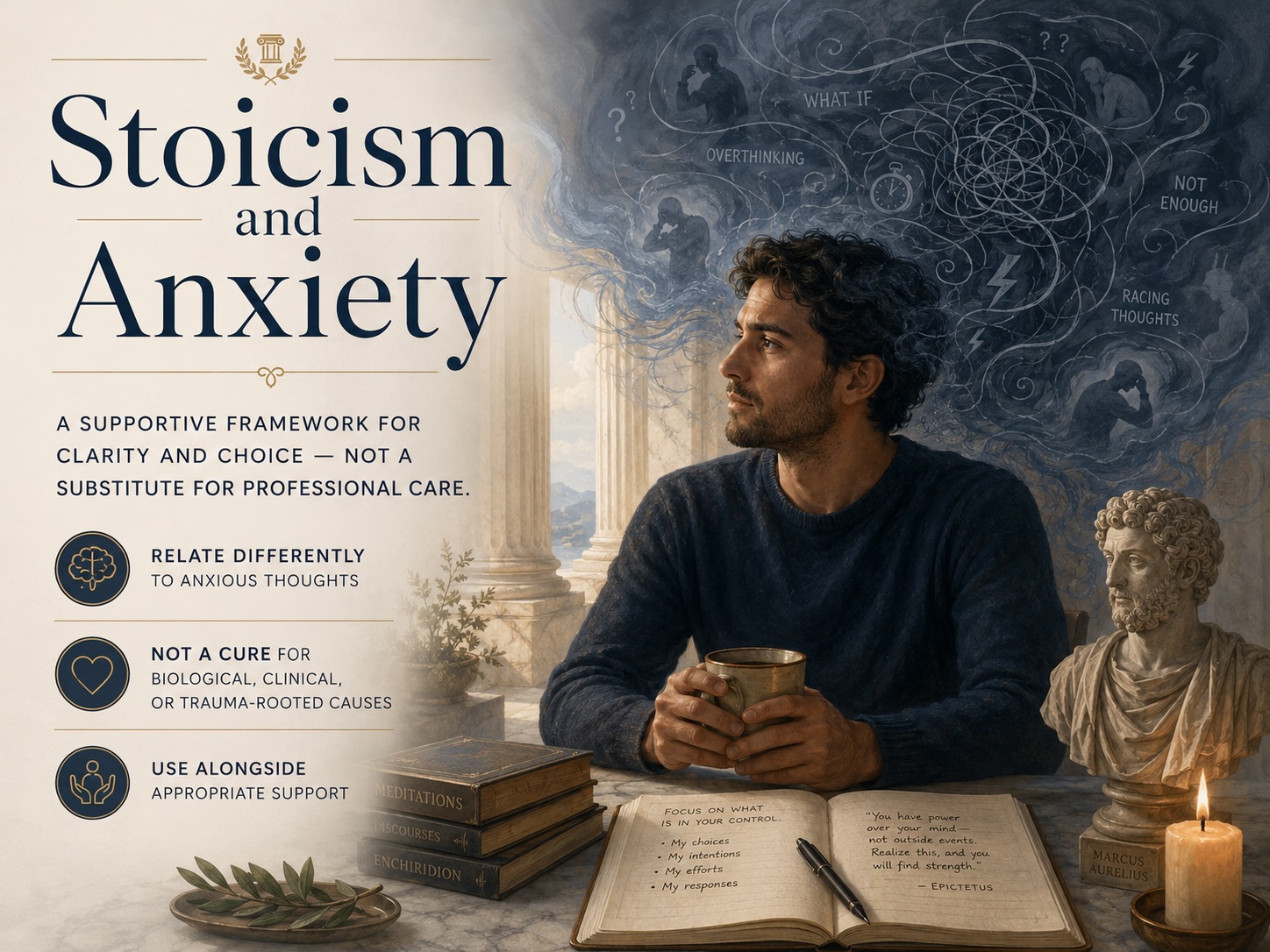
Thesis: Stoicism is a supportive framework for relating to anxious thoughts and sensations with more clarity and choice, but it is not a substitute for professional care, and it won’t eliminate anxiety’s biological, clinical, or trauma-rooted causes on its own.
WHAT STOICISM IS (AND ISN’T) IN THE CONTEXT OF ANXIETY
Stoicism is often misunderstood as emotional suppression: stiff upper lip, no feelings, no tears. That’s not the goal. The Stoics were interested in freedom—not freedom from emotion, but freedom from being yanked around by every impression, worry, and prediction.
In modern terms, Stoicism trains “response-ability”: the ability to pause between stimulus and response and choose a better action. That makes it relevant to anxiety, which tends to narrow your options and hurry your decisions. Anxiety says, “Act now or else.” Stoicism says, “Let’s check what’s true, what’s in our control, and what kind of person we want to be here.”
At the same time, Stoicism is not a clinical treatment plan. It doesn’t diagnose, prescribe medication, or replace therapy. It’s philosophy—practical philosophy, but still philosophy. Used well, it’s a companion to mental health care, not a competitor.
WHAT STOICISM CAN HELP WITH
- THE “SECOND ARROW”: ADDING SUFFERING TO SUFFERING
A helpful way to think about Stoicism and anxiety is to separate the initial experience from the story we build on top of it.
The first arrow might be: your heart races before a presentation. Your stomach drops when you see an unfamiliar number calling. You wake up at 3 a.m. with a jolt of dread.
The second arrow is what we add: “This proves I’m weak.” “I’m going to embarrass myself.” “If I feel this way, something terrible must be happening.”
Stoicism targets that second arrow. It asks you to notice the impression—“This is dangerous,” “This is unbearable”—and treat it as a claim, not a fact. The anxious mind speaks in absolutes. Stoic practice introduces a gentle cross-examination.
A short example: You’re about to send a message that could be misunderstood. Anxiety says, “If they react badly, it’ll be a disaster.” A Stoic approach is not “They’ll love it!” It’s: “I can’t control their interpretation. I can control my clarity and my tone. If it’s misunderstood, I can clarify. If they’re upset, I can respond calmly. I can handle discomfort.”
That doesn’t erase the nerves. It reduces the catastrophe.
- THE DICHOTOMY OF CONTROL: STOP FIGHTING REALITY
One of Stoicism’s most famous tools is the distinction between what is up to us and what isn’t. Anxiety often comes from trying to control what can’t be controlled: other people’s opinions, the future, the random turns of health and luck, the way life refuses to give guarantees.
Stoicism doesn’t say, “Don’t care.” It says, “Care wisely.”
What’s up to you: your choices, your attention, your preparation, your honesty, your boundaries, your willingness to ask for help.
What’s not up to you: whether you’re liked, whether the plane hits turbulence, whether the job market shifts, whether someone texts back quickly, whether your body never produces an anxious sensation again.
Anecdote: Someone I know used to refresh their inbox compulsively after sending proposals, convinced that vigilance could somehow influence outcomes. They were living as if attention were leverage. The Stoic shift was simple: send the proposal, follow up at a reasonable time, and then return to the work of the day. Not because outcomes don’t matter, but because obsessing isn’t action. The mind feels busy; life stays unchanged.
- REFRAMING DISCOMFORT: “I CAN ENDURE THIS”
Anxiety often convinces you that discomfort is intolerable. Stoicism trains the opposite message: discomfort is survivable, and often meaningful.
This doesn’t mean chasing pain or minimizing genuine suffering. It means practicing a realistic confidence: “This is hard, and I can bear it.”
That sentence alone can change the shape of an anxious moment. Instead of “I must make this go away,” you move to “I can carry this while I do what matters.”
This is especially useful for social anxiety, performance anxiety, and uncertainty anxiety. You can’t always remove the sensation. But you can remove the demand that you must feel calm before you act.
- VALUES-BASED ACTION: DO THE NEXT RIGHT THING
Anxiety loves to trap you in the mental realm: analysis, rehearsal, prediction, rumination. Stoicism brings you back to action—specifically, action aligned with virtue (character).
In a Stoic frame, the question shifts from “How do I feel?” to “What is the wise and kind thing to do here?” Not because feelings don’t matter, but because feelings aren’t always reliable guides.
A quick scenario: You’re anxious about a difficult conversation. Anxiety wants either avoidance (“Don’t bring it up”) or aggression (“Get it over with, make them wrong”). Stoicism suggests another path: speak honestly, respectfully, and at the right time; accept that you can’t control the outcome; measure success by your integrity, not by their reaction.
This is powerful because it gives you a win condition that anxiety can’t easily steal.
- PREMEDITATIO MALORUM: PREPARING WITHOUT SPIRALING
The Stoics practiced imagining possible difficulties in advance—not to terrify themselves, but to reduce surprise and increase readiness. Done well, this can calm anxiety. Done poorly, it becomes rumination.
The difference is intention and endpoint. Stoic preparation ends with a plan and a return to the present:
“What might happen?” “What would I do if it did?” “What resources or support would I need?” “Now, back to today.”
For example: If you’re anxious about travel, you can calmly consider delays, lost luggage, or missed connections and decide what you’d do. Pack essentials in a carry-on. Save important numbers. Arrive earlier. Then stop. You’ve extracted the useful part of worry and left the rest behind.
WHAT STOICISM DOESN’T HELP WITH (OR NOT ENOUGH)
- CLINICAL ANXIETY DISORDERS MAY REQUIRE MORE THAN PHILOSOPHY
If you’re dealing with panic disorder, severe generalized anxiety, OCD, PTSD, or debilitating symptoms, Stoicism can be supportive—but it may not be sufficient. Anxiety can be driven by nervous system dysregulation, trauma responses, genetics, and learned patterns that benefit from evidence-based treatment.
It’s not a Stoic failure to need therapy. It’s not a character flaw to need medication. If anything, it can be a Stoic act of wisdom to seek the right help.
A balanced Stoic stance is: “I will do what is up to me,” and that includes reaching out to professionals, following a treatment plan, and building a support network.
- STOICISM IS NOT EMOTIONAL NUMBING
Some people try to use Stoicism to bulldoze feelings: “I shouldn’t be anxious.” That tends to backfire. Anxiety responds poorly to self-criticism. It often grows in the dark, fed by resistance and shame.
Stoicism is not “I must not feel this.” It’s “I don’t have to obey this.”
You can feel anxious and still act with courage. You can feel uncertain and still be honest. You can feel fear and still be kind.
- STOICISM WON’T GIVE YOU CERTAINTY
A lot of anxiety is a demand for certainty: “Tell me I’ll be okay.” Stoicism doesn’t offer that. It offers something more durable: the ability to be okay even when you can’t be sure.
That’s not a slogan. It’s a practice. And it’s gradual. Some days the mind accepts it; other days it protests. Stoicism doesn’t promise a permanent state. It trains a way of returning.
WHEN TO SEEK PROFESSIONAL HELP (A STOICALLY WISE CHOICE)
Consider seeking professional support if anxiety is persistent and impairing—if it interferes with sleep, work, relationships, or basic functioning; if panic attacks are frequent; if you’re avoiding more and more of life; if you’re using substances to cope; if you’re experiencing intrusive thoughts that feel unmanageable; or if you have thoughts of self-harm.
Stoicism emphasizes courage, and courage includes asking for help. The Stoic goal isn’t to white-knuckle your way through everything alone. It’s to live well. Sometimes “living well” means bringing in trained allies.
A PRACTICAL STOIC MINI-PRACTICE FOR ANXIOUS MOMENTS
When anxiety spikes, try this simple sequence:
Name the impression: “My mind is telling me this is dangerous.” Separate control: “What is up to me right now? What isn’t?” Choose one virtuous action: “What is the next right step—small, concrete, doable?” Allow the feeling to ride along: “I can do this while feeling anxious.”
This is Stoicism in motion: not a lecture, not a debate with your mind, but a return to agency.
CONCLUDING TAKEAWAY
Stoicism won’t erase anxiety from the human experience, and it shouldn’t be used to shame you for having a nervous system that’s trying—sometimes clumsily—to protect you. What it can do is reduce the extra suffering: the catastrophizing, the self-judgment, the futile struggle for control, the belief that discomfort is intolerable.
It helps you trade “I must feel better before I live” for “I can live well, and feeling better can follow.”
If you want a framework that strengthens your response to anxious thoughts—while respecting the real limits of philosophy and the value of professional care—Stoicism is a steady, honest place to begin.
 Practice Stoicism every day.