Negative Visualization (Premeditatio Malorum) Without Becoming Pessimistic
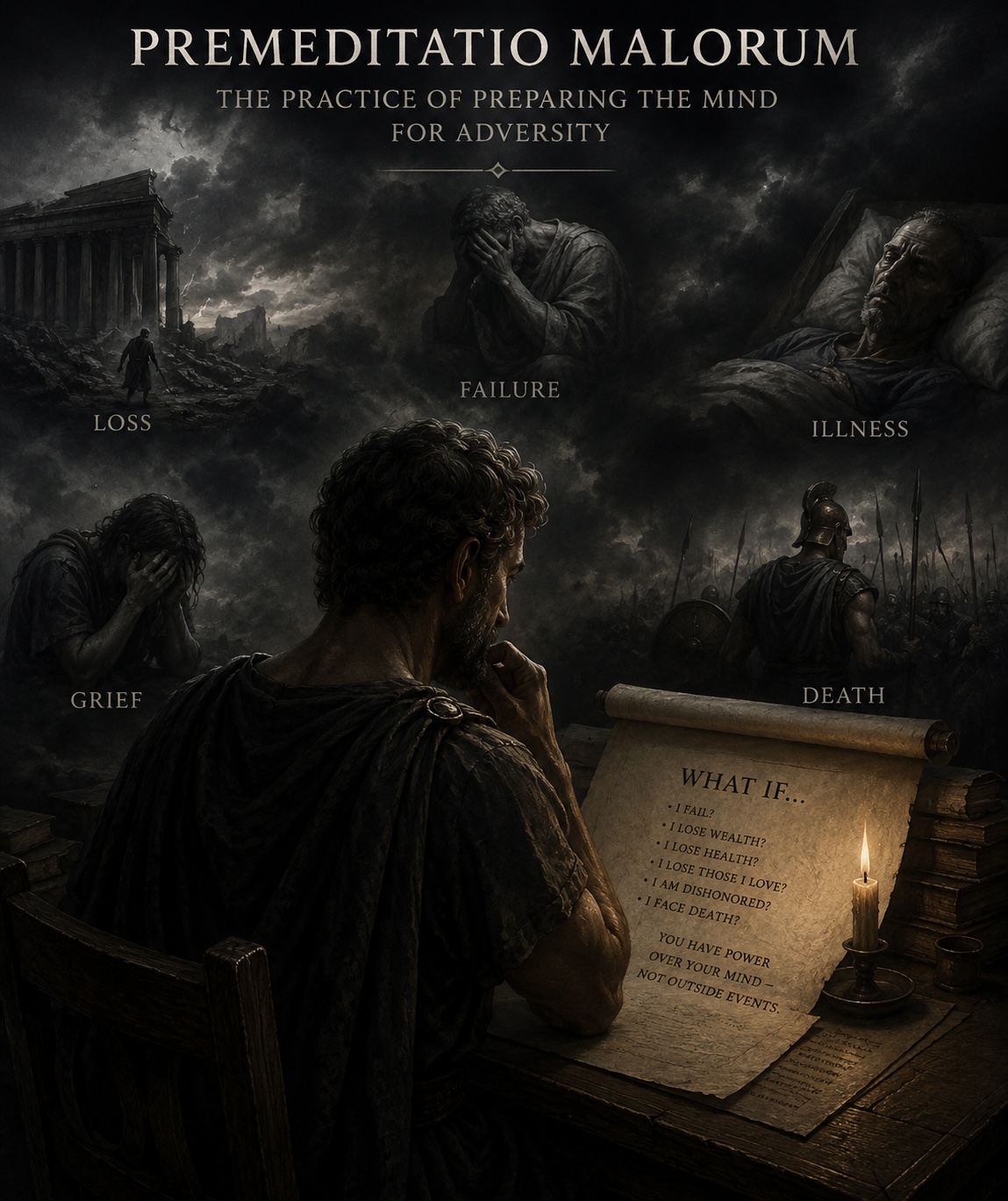
You don’t need a tragedy to remember what matters. A single missed train, a curt email, a minor health scare—small disruptions can shake us because we quietly assume the day will cooperate. The Stoics offered a different way: rehearse adversity before it arrives, not to darken your mood, but to steady your mind. Done well, negative visualization is like a fire drill for the soul: brief, practical, and oddly comforting. Done poorly, it becomes a private horror movie you keep replaying.
Thesis: Negative visualization is not about expecting the worst; it’s about preparing for what is possible, appreciating what is present, and practicing the response you want—briefly, safely, and on purpose.
WHAT NEGATIVE VISUALIZATION IS (AND ISN’T)
Premeditatio malorum literally means “the premeditation of evils,” but the phrase can mislead modern readers. The Stoic aim isn’t to become grim or suspicious of joy. It’s to reduce surprise. Surprise is what turns a setback into panic: “This shouldn’t be happening.” The Stoic adjustment is: “This can happen, and if it does, I can meet it.”
Negative visualization is a controlled exercise in imagining loss, inconvenience, or change—then pairing that imagination with two essential moves:
- gratitude for what you have right now, because you see it as contingent rather than guaranteed;
- rehearsal of your best response, because you remember your agency.
What it isn’t:
- It isn’t catastrophizing, where you spiral into ever-worsening scenarios and treat them as likely.
- It isn’t a test of endurance where you try to “handle” the most horrifying outcomes to prove toughness.
- It isn’t a substitute for planning, therapy, or medical advice when those are needed.
Think of it as a small dose of reality, taken voluntarily, so reality doesn’t have to force a large dose on you later.
WHY IT CAN TURN INTO WORRY
The line between practice and worry is thin. Many people cross it without noticing because the mind is good at disguising rumination as responsibility.
Worry feels like work. It feels like you’re doing something. But it usually produces no plan, no clarity, and no relief—only more mental noise.
Negative visualization becomes worry when:
- It’s frequent and unbounded (“What else could go wrong?”).
- It’s vague (“Everything will fall apart”) instead of specific (“I might get critical feedback on this project”).
- It focuses on helplessness (“I couldn’t survive that”) instead of response (“If that happened, here’s how I’d proceed”).
- It’s done to soothe anxiety in the moment, which can reinforce the habit of anxiety long-term.
- It’s done at night, when the brain is tired and the imagination is unchaperoned.
A simple test: after the exercise, do you feel more grateful and steady—or more tense and compelled to keep thinking? The first is practice. The second is a spiral.
THE STOIC SAFETY RAILS: BRIEF, SPECIFIC, PURPOSEFUL
To keep negative visualization from turning pessimistic, give it boundaries.
Brief: Set a time limit. One to three minutes is enough for most days. Even five minutes can be too long if you’re prone to rumination.
Specific: Choose one small, plausible scenario. The goal is not to exhaust the catalog of misfortunes. It’s to remind yourself: “Life includes friction.”
Purposeful: Decide what you’re training. Gratitude? Patience? Courage? Detachment from outcomes? Without a purpose, the mind will default to fear.
Here’s a simple template you can memorize:
Name one valued thing. “My morning with my partner.” “My health.” “This job.” “My ability to walk.” “Having a friend who answers my texts.”
Imagine its absence briefly. “What if this morning didn’t happen?” “What if I lost this job?” “What if my knee didn’t work the way it does?”
Return to the present with gratitude. “This is here now. I get it today.”
Rehearse a sane response. “If it changed, I would grieve, and then I would take the next right step.” “I would ask for help.” “I would simplify.” “I would begin again.”
The point is not to feel nothing. It’s to feel something on purpose, in a way you can carry.
A TWO-MINUTE PRACTICE YOU CAN USE TODAY
Try this once, preferably earlier in the day.
Minute 1: The Loss Pick one everyday pillar of your life: your phone, your commute, your voice, your relationship, your paycheck, your home, your reputation, your mobility. Now imagine a realistic disruption:
- Your phone breaks and you can’t access your calendar.
- A meeting goes poorly and you’re misunderstood.
- You wake up with a sore throat on the day of a presentation.
- Your car won’t start.
- Someone you care about is in a bad mood and withdraws.
Don’t elaborate. Don’t add a soundtrack. Just picture it plainly.
Minute 2: The Response Ask two questions:
- What would be within my control if this happened?
- What would “my best self” do in the first hour?
Then answer simply: “I would breathe and avoid sending reactive messages.” “I would tell the truth without drama.” “I would ask for a ride and adjust my plan.” “I would reschedule what I can and do one useful task.”
Finish with one sentence of gratitude: “Today, I still have what I’m afraid to lose.”
That’s it. Stop there. The stopping is part of the discipline.
A SHORT ANECDOTE: THE MISSED FLIGHT
A friend once told me about missing a flight to an important family event. He’d done everything “right”: arrived early, packed carefully, triple-checked the time. Then a highway accident turned the drive into a crawl. He missed the boarding by minutes.
Old pattern: panic, self-blame, frantic bargaining with gate agents, then simmering anger for hours.
New pattern: he’d been practicing negative visualization in a modest way. Not “my life will be ruined,” but “travel includes delays; plans can break.” In the car, stuck in traffic, he noticed the familiar surge—then he remembered the rehearsal.
He did two things: he called to say he was delayed, and he started looking for the next available route. When he finally sat down at the airport, he wasn’t cheerful, but he was composed. Later he said something that captures the point: “I didn’t avoid the problem. I avoided the extra suffering.”
Negative visualization didn’t make him pessimistic. It made him less surprised by friction—and therefore more capable.
WHAT TO VISUALIZE (AND WHAT TO AVOID)
Good targets are the “normal hard” parts of life:
- inconvenience
- criticism
- delays
- misunderstanding
- minor illness
- things breaking
- not getting what you want
- having to start over
These are common, and practicing them builds real resilience.
Be cautious with:
- vivid imagery of severe harm
- scenarios that mirror your deepest anxieties
- anything that reliably triggers panic or intrusive thoughts
Stoicism is about training the mind, not overwhelming it. If you notice that certain topics pull you into distress you can’t easily exit, choose smaller scenarios or shorten the time. The exercise should leave you steadier, not shaken.
HOW TO PAIR IT WITH GRATITUDE (THE ANTIDOTE TO PESSIMISM)
Gratitude is not the sugary denial of pain. In Stoic terms, it’s accurate perception: you see that what you love is not owed to you by the universe.
Negative visualization without gratitude becomes bleak: “Everything can be taken.” With gratitude, it becomes tender: “This is precious because it can change.”
A useful way to end the practice is to “re-enter” your life on purpose:
- Look at your surroundings and name one thing you’re glad exists.
- Send one kind message you’ve been postponing.
- Take care of something small (wash a dish, make the bed, step outside).
Gratitude should move you toward life, not just make you feel better about it.
WHEN TO PRACTICE (AND WHEN NOT TO)
Best times:
- morning, to set a steady tone
- before a difficult conversation, to reduce reactivity
- before travel, to normalize delays
- before launching work into the world, to accept criticism as possible
Times to avoid:
- right before sleep
- during acute anxiety
- when you’re already emotionally flooded
If you’re already overwhelmed, the Stoic move is often simpler: return to the breath, narrow the task, do the next right thing. Negative visualization is training, not triage.
THE CORE STOIC SHIFT: FROM “WHY ME?” TO “WHAT NOW?”
The deepest value of premeditatio malorum isn’t that it makes you tougher. It’s that it makes you less entitled to a frictionless day—and more committed to a wise response.
Life will still disappoint you. People will still misunderstand you. Plans will still break. But the sting changes when you’ve already accepted, in principle, that these things belong to the human package.
You stop asking, “How could this happen?” and start asking, “Given that it happened, what is the honorable, effective next step?”
CONCLUDING TAKEAWAY
Negative visualization is a tool for appreciation and preparedness, not a lifestyle of dread. Keep it brief. Keep it specific. Give it a purpose. Pair it with gratitude and a concrete rehearsal of your response. Then stop.
Used this way, premeditatio malorum doesn’t make you pessimistic. It makes you present—aware that what you have is fragile, and that you are capable.
 Practice Stoicism every day.