Negative Visualization (Premeditatio Malorum)
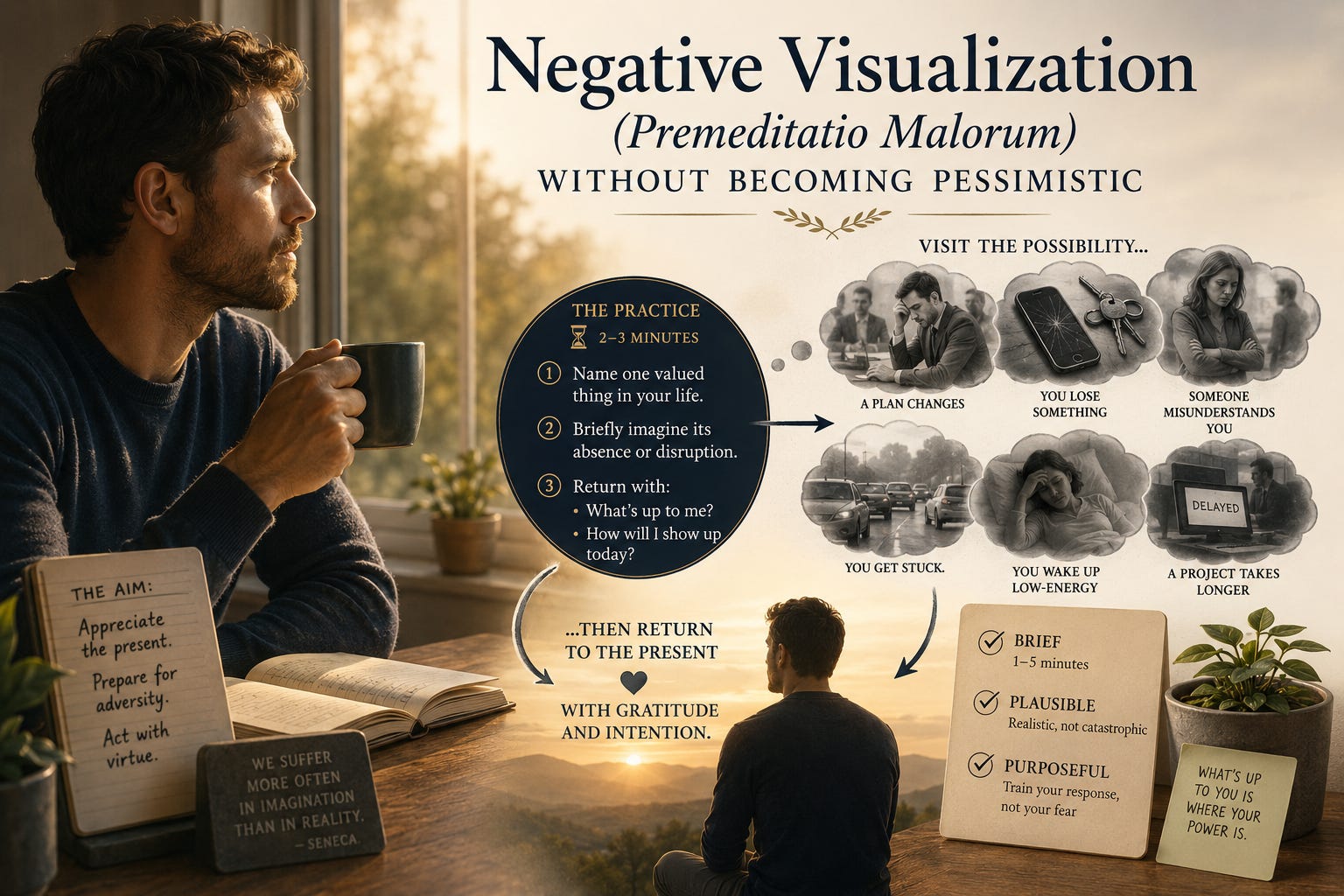
You don’t need a tragedy to remember what matters. You can remember it on an ordinary Tuesday, while your coffee is still warm and your phone hasn’t buzzed yet. The Stoics had a practice for this: negative visualization, or premeditatio malorum—briefly imagining loss, difficulty, or disruption before it happens. Done well, it makes the day feel more precious and your mind more prepared. Done poorly, it turns into a rehearsal of anxiety.
Here’s the thesis: Negative visualization is not a tool for worrying about the future; it’s a tool for appreciating the present and training your response to setbacks. The difference comes down to intention, duration, and what you do immediately afterward. Practice it briefly, safely, and purposefully—and it becomes gratitude with backbone, not pessimism in disguise.
WHAT NEGATIVE VISUALIZATION IS (AND ISN’T)
Negative visualization is a controlled thought exercise: you picture a plausible inconvenience or loss, not to suffer twice, but to reduce surprise and strengthen perspective. You “visit” a difficult possibility on purpose, then return to the present with clearer priorities.
It is not:
- A prediction (“This will happen.”)
- A rumination loop (“What if… what if… what if…?”)
- A self-punishment ritual (“I don’t deserve good things.”)
- A replacement for practical planning (“I imagined it, so I’m prepared.”)
The Stoic aim is simple: to align your expectations with reality. Reality includes delays, misunderstandings, sickness, rejection, broken items, and endings. If you live as if none of that is possible, you’ll experience normal life as an outrage. If you remember it’s possible, you can meet it with steadier hands.
WHY IT SOMETIMES TURNS INTO WORRY
People often try negative visualization the way they scroll the news: endlessly, emotionally, and without a clear endpoint. The mind doesn’t interpret that as training. It interprets it as danger.
Worry has a certain flavor. It’s repetitive, sticky, and vague. It keeps asking for certainty and never gets it. It tries to control feelings by controlling outcomes, which is a losing strategy because outcomes aren’t fully yours.
Negative visualization, by contrast, is deliberate and bounded. It ends with a return: “If that happened, what would be up to me? What would still be good? What could I do?” It doesn’t chase certainty. It trains agency.
A quick self-check: after the exercise, do you feel more grounded and grateful, or more tense and scanning for threats? If it’s the second, you didn’t do something “wrong” morally—you just need tighter constraints and a different emphasis.
THE SAFE FRAME: BRIEF, PLAUSIBLE, PURPOSEFUL
If you want this practice to build resilience rather than anxiety, keep it inside three guardrails.
Brief: Set a time limit. One minute. Two minutes. Five, at most. This is not a meditation retreat into catastrophe. It’s a mental drill.
Plausible: Choose things that could realistically happen, not cinematic disasters. “My meeting could go badly” is plausible. “My entire life will collapse because I said one awkward sentence” is not. The point is to prepare for normal adversity, not to terrify yourself into numbness.
Purposeful: Know what you’re training. Gratitude? Patience? Composure? Courage? If you can’t name the purpose, your mind will default to fear. Purpose is the steering wheel.
A SIMPLE THREE-STEP PRACTICE (2–3 MINUTES)
Step 1: Name one valued thing in your life right now. Not a vague concept—something specific: your partner’s laugh, your health, your job, your ability to walk, a friend who checks in, a quiet home, a working laptop, your eyesight, your dog’s presence at your feet.
Step 2: Briefly imagine its absence or disruption. Keep it plain and unsensational. “What if I didn’t have this?” “What if it changed?” Let the mind register the contrast. This is where gratitude is born—not from positivity slogans, but from recognizing contingency.
Step 3: Return with two questions.
- If that happened, what would still be up to me?
- Given that it hasn’t happened today, how do I want to treat this person/thing right now?
Then stop. Don’t negotiate with the thought. Don’t keep going “just to be thorough.” Thoroughness is how worry pretends to be responsibility.
AN ANECDOTE: THE MISSED TRAIN
A friend once told me about missing a train by thirty seconds. Doors closed. Platform emptied. The familiar surge arrived: anger, self-blame, the fantasy of time travel. He’d been practicing negative visualization and tried something that surprised him.
He said, almost like a script: “Of course trains leave. Of course I can be late. Of course plans get disrupted.” Then he asked: “What’s up to me now?”
He bought the next ticket. He texted the person he was meeting without drama. He used the extra time to walk outside the station instead of spiraling on a bench. The situation didn’t become “good,” but it also didn’t become a personal catastrophe.
That’s the real promise of premeditatio malorum: not that you’ll feel nothing, but that you’ll recover faster and behave better.
WHAT TO VISUALIZE: THE “SMALL LOSS” MENU
If you’re prone to anxiety, start small. Think in terms of inconveniences and everyday fragility:
- A plan changes at the last minute
- Someone misunderstands you
- You receive criticism
- You lose an item
- You get stuck in traffic
- You wake up low-energy
- A project takes longer than expected
- A friend is distracted or unavailable
These are not “minor” in their impact; they’re minor in their stakes. They’re perfect training grounds because they happen often enough to give you practice, and they’re manageable enough to keep your nervous system from going on full alert.
Over time, you can carefully widen the scope—health, aging, endings—but only if you can do it without flooding yourself. Stoicism is not about white-knuckling through dread. It’s about meeting reality with proportion.
HOW TO KEEP IT FROM TURNING INTO DOOM
Use these internal cues to stay on track.
Keep the lens on response, not imagery. The goal isn’t to create a vivid movie of misfortune. The goal is to rehearse your character: patience, fairness, courage, self-control.
Don’t stack scenarios. Worry stacks: “And then this, and then this, and then this…” Negative visualization chooses one scenario and ends. One door closes. You don’t burn down the whole city.
Pair it with gratitude immediately. If you imagine losing your health, come back to the fact that you can breathe right now. If you imagine losing a relationship, come back to how you can show up today. Gratitude is the landing pad.
Add a micro-action. After the exercise, do something small that matches your values. Send the kind message. Drink water. Start the task you’ve been avoiding. Put your keys in the same place. The action tells your brain: “This was preparation, not panic.”
Know when not to do it. If you’re already in a high-stress state, sleep-deprived, or prone to spirals, skip it or shorten it to ten seconds. Stoic discipline includes choosing the right tool for the day. A practice meant to strengthen you should not regularly destabilize you.
PREMEDITATIO MALORUM AS LOVE, NOT FEAR
There’s a misconception that negative visualization is bleak. But at its best, it’s an act of love.
To imagine that someone dear to you won’t always be here isn’t to curse the relationship. It’s to stop sleepwalking through it. It’s to become less stingy with appreciation. Less casual with your words. Less confident that you can always repair things “later.”
Likewise, to imagine losing your comfort isn’t to become grim. It’s to notice the comfort you have and to build a self that can stand without it if needed.
The Stoics weren’t collecting dark thoughts like trophies. They were trying to live awake.
CONCLUDING TAKEAWAY
Negative visualization is a scalpel, not a sledgehammer. Use it briefly. Keep it plausible. Aim it at your response. Then return to the present with gratitude and a small act of intention.
If the practice makes you more tender toward your life and more steady in the face of disruption, it’s working. If it makes you jittery and fixated, tighten the time limit, lower the stakes, and shift the focus from “what might happen” to “what I will do if it does.”
You don’t rehearse adversity because you expect the worst. You rehearse it so you can meet whatever comes without losing your best self.
If you want more practical Stoic exercises like this—short, usable, and grounded—subscribe if that’s your kind of daily training.
 Practice Stoicism every day.