A Stoic Morning Routine for Intermediate Practitioners (15–30 Minutes)
The day doesn’t usually go off the rails at noon. It happens earlier—when you check your phone before you’ve checked your mind, when you start moving before you’ve decided what matters, when you let other people’s urgency choose your priorities. By the time you notice you’re tense, distracted, or reactive, the tone is already set. A Stoic morning routine isn’t about becoming serene before sunrise; it’s about taking the steering wheel before the road gets crowded.
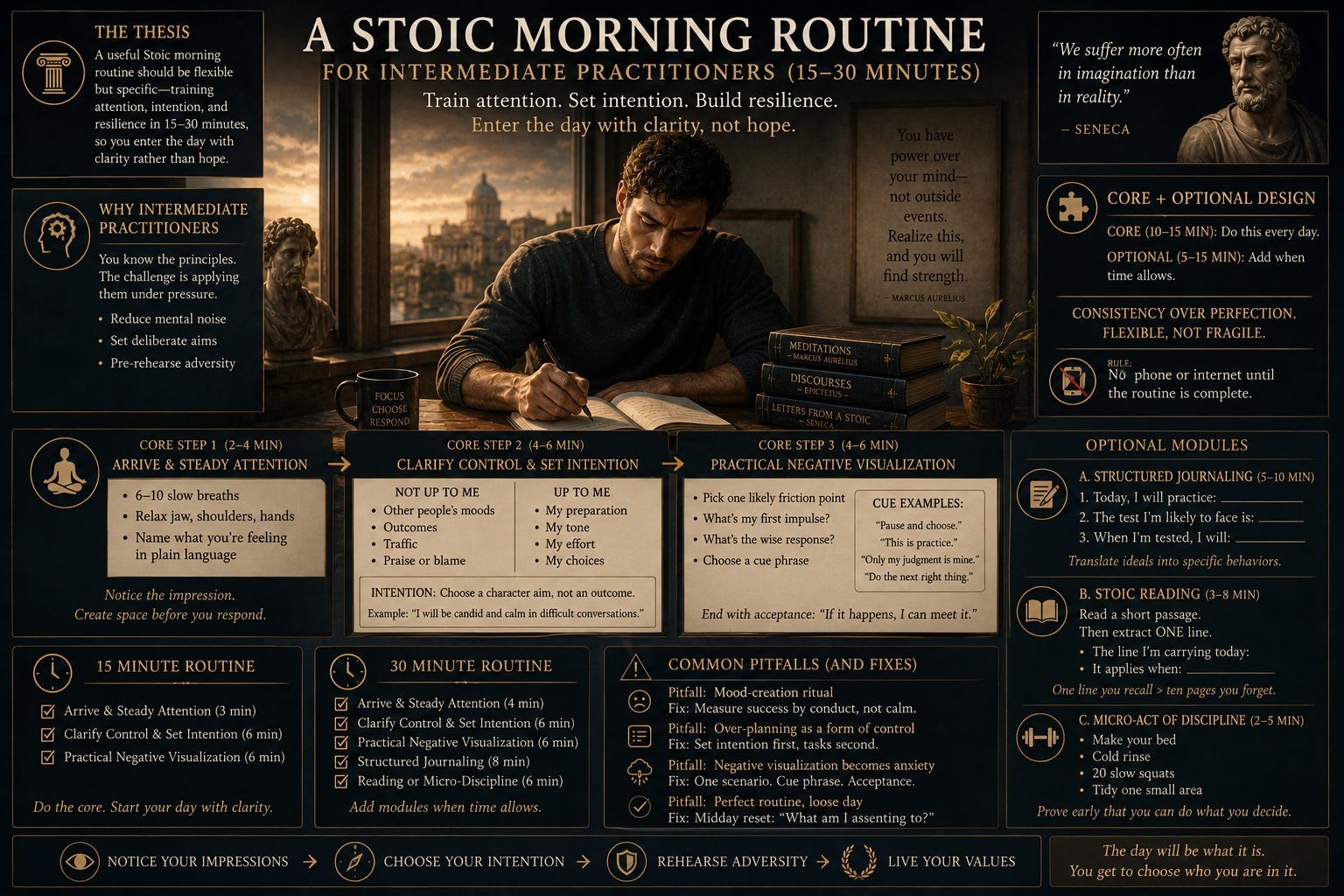
Thesis: A useful Stoic morning routine should be flexible but specific—training attention (what you notice), intention (what you choose), and resilience (how you respond) in 15–30 minutes, so you enter the day with clarity rather than hope.
Below is a structure you can adapt without turning your morning into a fragile ritual. Think of it like a warm-up: short, repeatable, and designed for real life.
WHY INTERMEDIATE PRACTITIONERS NEED A DIFFERENT ROUTINE
Beginners often need simple reminders: focus on what you can control, don’t chase externals, be virtuous. Intermediate practitioners usually know the principles. The problem is application under speed.
You’ve likely had days where you could explain Stoicism perfectly—while still snapping at someone, procrastinating, or spiraling internally. That’s not hypocrisy; it’s the gap between knowing and training. The morning is the easiest place to train because the day hasn’t started arguing with you yet.
A good intermediate routine does three things:
1) It reduces mental noise so you can actually notice impressions forming.
2) It sets a small number of deliberate aims so you’re not improvising your character.
3) It pre-rehearses adversity so surprises don’t steal your agency.
THE 15–30 MINUTE FRAME: YOUR NON-NEGOTIABLES AND YOUR FLEX
To keep this flexible, use a “core + optional” design.
Core (10–15 minutes): You do this even on busy days.
Optional (5–15 minutes): You add this when time allows.
If you have 15 minutes total, do only the core. If you have 30, add one or two optional modules. The point is consistency without brittleness.
Before we begin: if your first move is reaching for your phone, consider a simple boundary—no internet until the routine is complete. Not forever. Just long enough to choose your mind before the world chooses it for you.
CORE STEP 1 (2–4 MIN): ARRIVE AND STEADY ATTENTION
Sit or stand somewhere quiet. Nothing fancy. The goal is to stop the internal momentum that carries you into the day half-asleep.
Do this:
- Take 6–10 slow breaths.
- On each exhale, relax your jaw, shoulders, and hands.
- Name what you’re experiencing in plain language: “Tired.” “Restless.” “Eager.” “Anxious.” “Fine.”
This is not mindfulness as decoration. In Stoic terms, you’re creating a small gap between impression and assent. If you can’t notice your state, you’ll obey it.
Example: You wake up with a vague dread. If you don’t name it, you’ll treat it like a prophecy. If you name it—“anxious, probably about the meeting”—it becomes an impression you can examine, not a command you must follow.
CORE STEP 2 (4–6 MIN): CLARIFY CONTROL AND SET INTENTION
This is the backbone: distinguishing what is up to you from what isn’t, then choosing your aims accordingly.
Ask two questions and answer them in one or two sentences each (out loud or on paper):
1) What is not up to me today?
Be concrete. “Other people’s moods.” “The outcome of the pitch.” “Traffic.” “Whether I’m praised.”
2) What is up to me today?
Again, concrete. “My preparation.” “My tone.” “My honesty.” “My patience.” “My effort.”
Then set one intention that expresses your character, not your outcome. Keep it small enough to remember at noon.
Examples of character intentions:
- “I will be candid and calm in difficult conversations.”
- “I will do the next right thing even when I don’t feel like it.”
- “I will treat interruptions as practice, not insults.”
- “I will choose accuracy over drama.”
A short anecdote: A friend of mine used to start mornings by writing a to-do list that looked like a threat. He’d finish the list and still feel behind. He changed one thing: before tasks, he wrote a single intention—“Be unhurried and precise.” The tasks didn’t shrink, but his experience did change. He stopped measuring the day only by completion and started measuring it by conduct. That’s Stoic leverage.
CORE STEP 3 (4–6 MIN): NEGATIVE VISUALIZATION, BUT PRACTICAL
Intermediate practitioners often avoid this because it sounds gloomy, or they do it in a way that becomes rumination. The aim is neither dread nor rehearsed suffering. It’s preparedness.
Pick one likely friction point today. Not five. One.
Examples:
- Someone will be curt with you.
- A plan will change.
- You’ll feel tempted to procrastinate.
- You’ll receive criticism.
- You’ll be tired in the afternoon and want to quit early.
Now run a brief rehearsal:
- If this happens, what will my first impulse be?
- What would the wise response look like?
- What phrase can I use as a cue?
Cue phrases matter because you won’t have time for philosophy when you’re activated. Choose something short:
- “Pause and choose.”
- “This is practice.”
- “Only my judgment is mine.”
- “Do the next right thing.”
Then add one line of acceptance: “If it happens, I can meet it.” Not “I’ll like it.” Not “It won’t matter.” Just: “I can meet it.”
This is resilience training. You’re inoculating yourself against surprise.
OPTIONAL MODULE A (5–10 MIN): JOURNALING THAT DOESN’T TURN INTO A NOVEL
If you have time, write. But keep it structured so it doesn’t become a diary spiral.
Use three prompts:
1) Today, I will practice: (one virtue or behavior)
2) The test I’m likely to face is: (one situation)
3) When I’m tested, I will: (one specific action)
Example:
1) Today, I will practice: fairness.
2) The test I’m likely to face is: a colleague taking credit.
3) When I’m tested, I will: ask a clarifying question calmly and document my work without bitterness.
This is the intermediate move: translating ideals into behaviors. “Be virtuous” is too vague at 9:40 a.m. “Ask one calm clarifying question” is actionable.
OPTIONAL MODULE B (3–8 MIN): READ A SMALL STOIC PASSAGE—THEN EXTRACT ONE LINE
If you read Stoic material in the morning, do it like strength training, not like scrolling.
Read a short passage. Then write one sentence:
- “The line I’m carrying today is: ________”
- “It applies when: ________”
The point is not to consume wisdom; it’s to carry a tool into the day. One line you can recall is worth more than ten pages you forget.
OPTIONAL MODULE C (2–5 MIN): A MICRO-ACT OF DISCIPLINE
Stoicism isn’t only internal. It’s training the will in small ways so it shows up in big ways.
Choose one brief act of discipline:
- Make your bed without resentment.
- Take a short cold rinse or end the shower cooler than you prefer.
- Do 20 bodyweight squats slowly and with control.
- Tidy one small area you’ll see later.
This is not about toughness for its own sake. It’s about proving, early, that you can do what you decide—especially when comfort disagrees.
A note for intermediate practitioners: If your discipline acts become performative or punishing, scale them down. The goal is steadiness, not self-violence.
PUTTING IT TOGETHER: TWO SAMPLE ROUTINES
If you have 15 minutes:
- Arrive and steady attention (3 minutes)
- Clarify control + set intention (6 minutes)
- Practical negative visualization (6 minutes)
If you have 30 minutes:
- Arrive and steady attention (4 minutes)
- Clarify control + set intention (6 minutes)
- Practical negative visualization (6 minutes)
- Structured journaling (8 minutes)
- Micro-act of discipline or short reading (6 minutes)
Notice what’s missing: a rigid sequence that collapses if your morning is messy. This routine is modular. If you oversleep, you don’t abandon it—you compress it.
COMMON PITFALLS (AND HOW TO FIX THEM)
Pitfall: Turning the routine into a mood-creation ritual.
Fix: Measure success by conduct, not calm. Some mornings you’ll feel unsettled. Your job is to act well anyway.
Pitfall: Over-planning the day as a form of control.
Fix: Set intention first, tasks second. Let your character lead your calendar.
Pitfall: Negative visualization becoming anxiety.
Fix: Keep it to one likely scenario and end with a cue phrase and acceptance. Rehearse response, not catastrophe.
Pitfall: Doing the routine perfectly and living the day loosely.
Fix: Add one midday “reset question”: “What am I assenting to right now?” Even 10 seconds helps.
123 My Bot

Your website should do more than sit there.
123MyBot gives your business an AI chatbot that engages visitors, answers questions, and helps turn traffic into real leads—without a complicated setup.
Get started in 1-2-3:
Add it. Customize it. Let it work.
See how it works
Simple AI chatbot lead capture for real businesses.
A FINAL TAKEAWAY
A Stoic morning routine is not a shield that prevents difficulty. It’s a training ground that prevents difficulty from taking your mind hostage. In 15–30 minutes, you can practice the essentials: notice your impressions, choose your intention, and rehearse meeting adversity with dignity. The day will still be the day—unpredictable, occasionally unfair, often noisy. But you’ll meet it as an active participant rather than a dragged passenger.
If you want more routines like this—practical, flexible, and built for real mornings—subscribe if you’re trying to live the philosophy instead of just thinking about it.
 Practice Stoicism every day.